
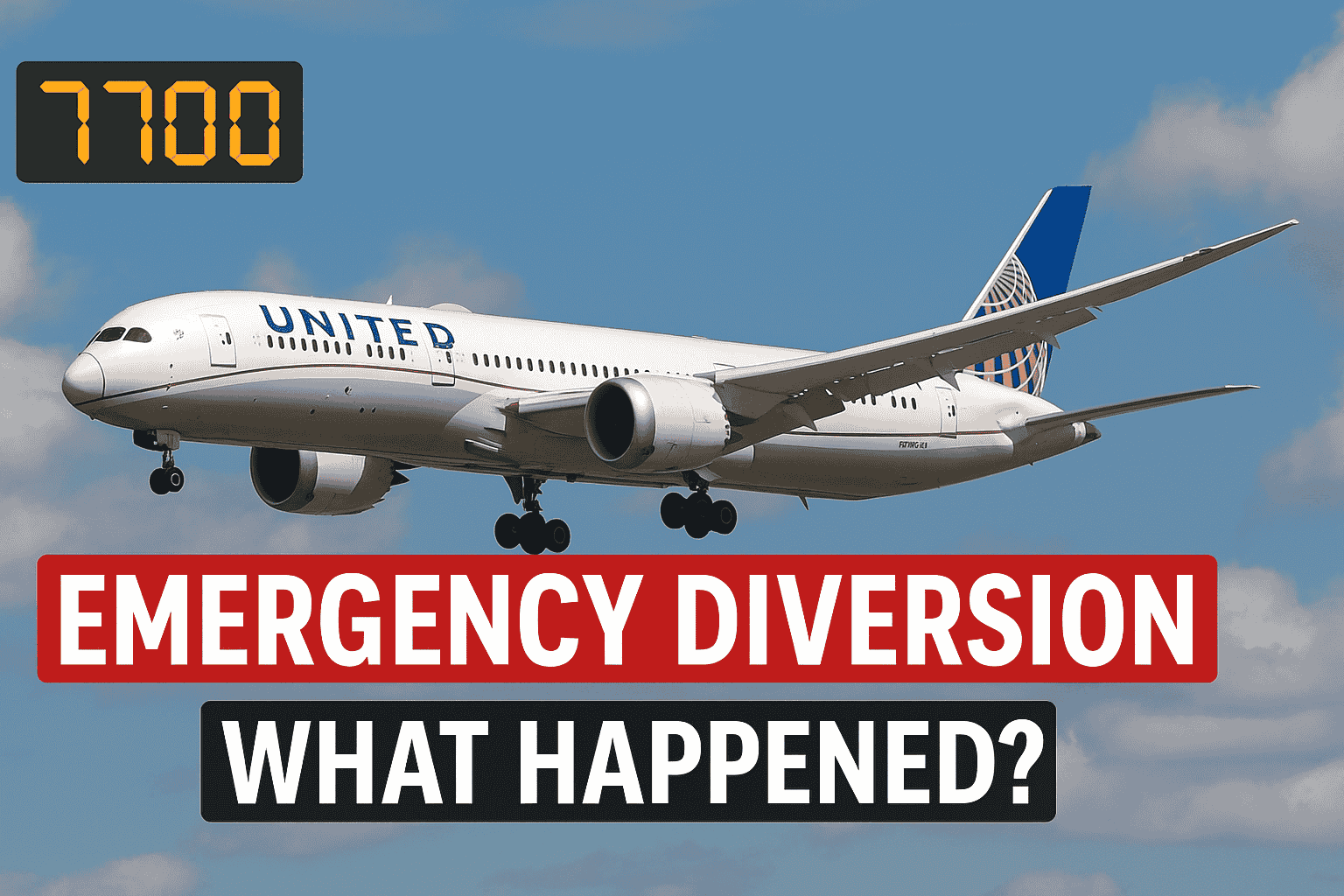
Have you heard about the United Airlines Flight UA770 Emergency Diversion that shocked travelers recently? In this article, you’ll learn exactly what happened on UA770, why it diverted, and what this means for passenger safety. Expect clarity, real stories, and expert insight—all in plain English from a friend.
Why United Airlines Flight UA770 Emergency Diversion Occurred
This section explains the emergency behind the diversion.
A Sudden Mid‑Air Alert
Just 90 minutes after departure, United Airlines Flight UA770 Emergency Diversion was triggered when pilots squawked code 7700—signaling a general emergency . The Boeing 787‑9, registered N26902, was en route from Barcelona to Chicago when the alert prompted an immediate diversion.
Choosing London Heathrow
The reason United Airlines Flight UA770 Emergency Diversion headed to London is simple—Heathrow was the closest major international airport equipped for emergency protocols. Air traffic control rerouted UA770 to Heathrow Runway 27R, where it landed safely at 4:55 PM BST .
What Passengers Experienced during the Emergency Diversion
Here’s what travelers went through during this high‑stakes event.
Calm Crew, Confident Passengers
Passengers on United Airlines Flight UA770 Emergency Diversion reported the cabin crew remained composed. Clear, calm announcements reassured everyone—even as the aircraft descended toward an unexpected landing in London . One traveler shared, “We were told about the issue, the crew was composed, and honestly, most of us were just glad it was handled early.”
Smooth Landing and Aftercare
UA770 touched down without incident. First responders stood by but weren’t needed. Passengers disembarked and were supported with meal vouchers, rebooking, and accommodations—classic United Airlines Flight UA770 Emergency Diversion protocol .
Also Read: Tragic Discovery: 5 Missing Skiers Found Dead in Swiss Alps
Behind the Scenes – Crew, ATC & Protocols
A quick look at how airlines and airports manage such emergencies.
Pilot Training Saves the Day
When the United Airlines Flight UA770 Emergency Diversion was announced, pilots followed rigorous training: alert ATC, declare squawk 7700, land immediately. These steps aren’t dramatics—they’re routine practice for preserving safety .
Air Traffic & Ground Coordination
Air traffic control cleared airspace while London’s emergency teams readied landing zones. That’s why United Airlines Flight UA770 Emergency Diversion to Heathrow was seamless—the infrastructure and communication systems were already in synchronized motion.
What Caused the Diversion?
This section explores possible reasons behind the emergency flag.
Bottom line? United has yet to officially disclose the exact reason behind the emergency diversion of Flight UA770, but here’s what appears most likely.
- Mechanical alert—a warning light or pressurization concern triggered the diversion .
- Medical emergencies rarely, diversions occur because a passenger needs urgent care. No reports confirm this for UA770 .
United Airlines Flight UA770 Emergency Diversion remains under investigation, but safety-first protocols are designed precisely for such unknown situations.
Real‑Life Comparison & Context
Putting UA770’s diversion in perspective.
How UA770 Stacks Up
The United Airlines Flight UA770 Emergency Diversion follows other well-known safety diversions:
- United Flight 1175 engine alert handled mid‑air in 2018 .
- Flight 328’s engine failure over Denver in 2021—but UA770 had no visible smoke or debris .
In comparison, UA770’s diversion was precautionary and fully controlled—testament to the carrier’s commitment to safety.
Why It Matters in 2025
Summer 2025 sees record travel demand. A sudden United Airlines Flight UA770 Emergency Diversion reminds us that, even in high-traffic seasons, airlines prioritize safety over schedule. It’s a reassurance that protocols work—even under pressure .
What Passengers Should Take Away
Learn how to stay prepared and confident when flying.
- Disruptions aren’t disasters—UA770 landed safely; diversions happen to keep things safe.
- Trust the system—from trained pilots to air traffic coordination, your safety is the priority.
- Be flight‑ready—carry essentials and remain flexible when schedules change.
- Know your rights—vouchers, rebooking, and assistance are part of airline safety protocols.
Frequently Asked Questions
Answering real reader curiosities.
- Q: Is everyone okay?
A: Yes—no injuries reported during the United Airlines Flight UA770 Emergency Diversion. - Q: How common are diversions?
A: About 1 in 1,500 flights may divert—but most are precautionary, not catastrophic. UA770 is an example of safety protocols in action . - Q: Will UA770 resume?
A: The plane is being inspected at Heathrow. Passengers are being rebooked or resumed on later flights.
Conclusion
The United Airlines Flight UA770 Emergency Diversion stands as a strong reminder: when safety matters, no schedule is king. From the squawk 7700 alert to the composed landing at Heathrow, every step underscored the sophistication of global aviation safeguards.