
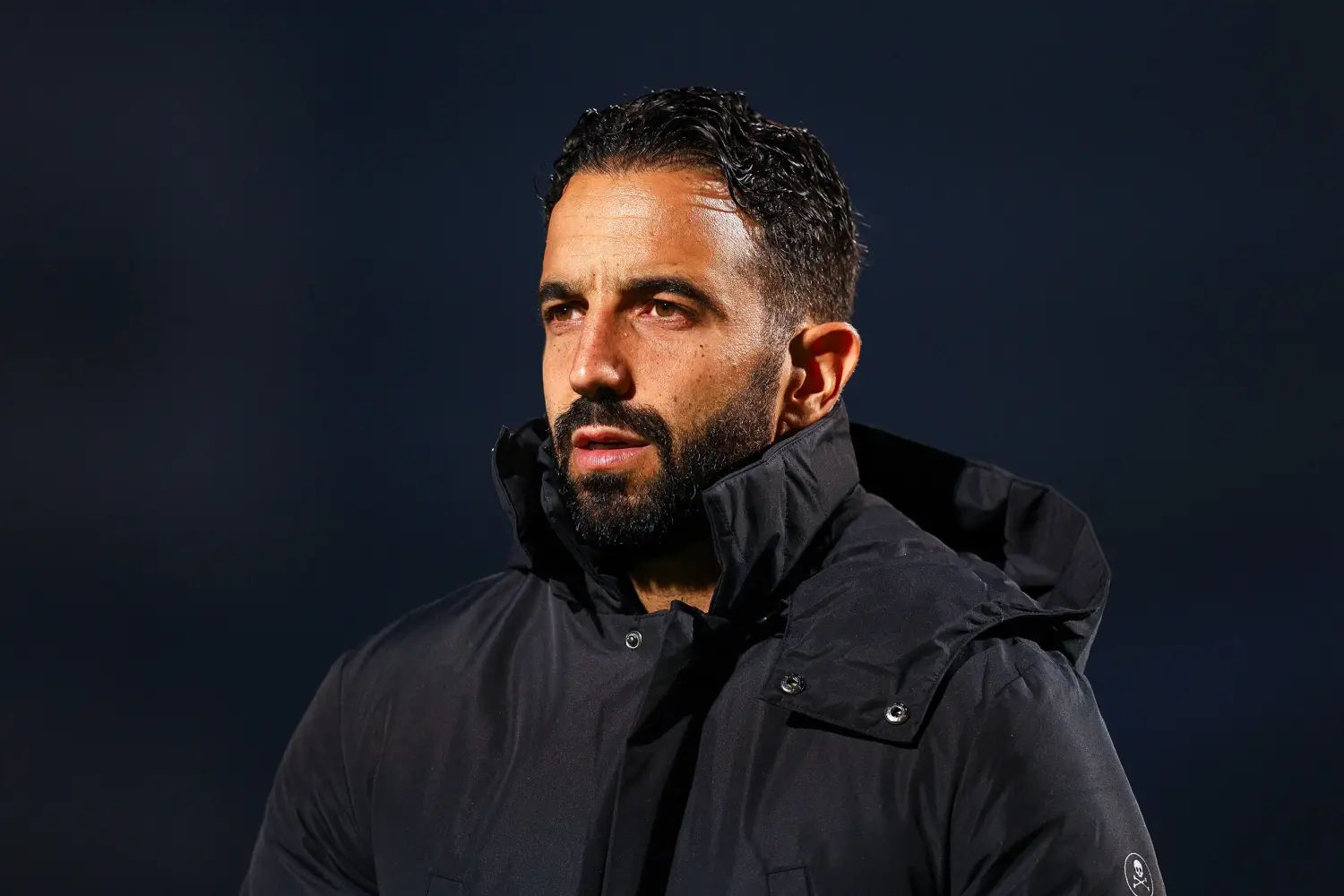
Ruben Filipe Marques Amorim’s story traces the path of a football scholar who transformed from industrious Portuguese midfielder into one of Europe’s most methodical tacticians. Born on 27 January 1985 in Lisbon, his journey represents football’s newest archetype: analytical, emotionally intelligent, and utterly modern.
The Player Before the Professor
Amorim’s playing career began quietly at Belenenses, but by 2008 he had caught Benfica’s eye. During nine years in red he collected ten major trophies and established himself as a team‑first midfielder capable of balancing defence and creativity. He wasn’t flamboyant; his gift was temperament. Constant injuries limited his appearances but polished a different skill—observation. Many future coaches learn on touchlines; Amorim learned while watching others play.
His international career included 14 caps for Portugal and two World Cups. Those tournaments highlighted not individual brilliance but his collective intelligence—an instinct to organise, cover, and communicate. Traits of a manager were already forming.
Discovering the Manager Within
When Amorim retired in 2017, he wasted no time. By the following year he was managing Casa Pia in Portugal’s third tier. Early results were shaky, but what defined him was adaptation: switching to a three‑at‑the‑back formation that stabilised the team and kick‑started a winning run. That 3‑4‑3 setup would become his signature system across every club he later guided.
His brief but electric spell at Braga confirmed his credentials. Promoted from the B team to the senior side mid‑season, Amorim led them to a League Cup triumph against FC Porto and climbed the league table with incisive football. He had achieved in three months what many managers need years for—a coherent identity.
The Sporting CP Revolution
In March 2020 Sporting CP paid a record €10 million buy‑out fee to secure Amorim’s services, making him the third most expensive managerial transfer ever. The gamble paid off immediately. Within a single season he ended Sporting’s 19‑year title drought, blending academy graduates with disciplined veterans.
Tactical Blueprint:
Amorim’s three central defenders ensured stability; wing‑backs attacked ferociously while coverage rotated behind them. In midfield, the double pivot dictated tempo, allowing dynamic forwards such as Pedro Gonçalves and Nuno Santos to roam freely. The beauty of his design lay in balance—every surge forward met with measured protection.
Cultural Shift: Amorim’s leadership went beyond the chalkboard. He demolished the wall between senior and youth squads, giving teenage talents genuine responsibility. Training sessions emphasised repetition, ball circulation, and collective intensity rather than set‑piece secrecy. The result was a team that not only won but understood why it was winning.
Under Amorim, Sporting became more than a club emerging from crisis; it became a model of modern Portuguese management. Between 2020 and 2024 he won two Primeira Liga titles, two League Cups, and the Supertaça, while keeping Sporting profitable and unified—an achievement rarely seen in Southern Europe’s volatile football environment.
The Manchester United Chapter
Manchester United’s decision in late 2024 to appoint Ruben Amorim after Erik ten Hag’s exit signalled a shift towards structural thinking. The club that once thrived on Ferguson’s culture of evolution needed a tactical scientist rather than another celebrity coach. Amorim fit perfectly: analytical, self‑critical, and fluent in both data and emotion.
His contract, running until 2027, underpinned a long‑term rebuild. Early performances oscillated between fluid brilliance and frustrating inconsistency—a predictable pattern for any system overhaul. Amorim inherited an unbalanced squad and, true to character, admitted candidly, “We are far from perfection.” Such honesty endeared him to fans tired of managerial platitudes.
Tactics at United: The 3‑4‑3 again took centre stage. Full‑backs became wing‑backs, centre‑halves like Lisandro Martínez learned to step into midfield, and attackers such as Marcus Rashford and Alejandro Garnacho swapped flanks with fluidity. Possession was purposeful rather than decorative. Pressing aimed at timing, not chaos.
Man‑Management: Amorim’s philosophy mirrors mentorship rather than instruction. He urges players to “fight each other” in the sense of pushing one another competitively within the team—a metaphor for accountability. Where some coaches discipline through fear, Amorim cultivates responsibility through belonging.
Influence and Mentorship
Amorim frequently credits three names:
- Jorge Jesus, under whom he played at Benfica, for teaching tactical variety and work‑rate.
- José Mourinho, for strategic pragmatism and psychological insight.
- Pep Guardiola, for the art of positional play and player evolution.
He synthesizes them into his own formula: attack with emotion, defend with intellect, and communicate with clarity. He rarely talks about referees or controversies—preferring to “stay healthy” by focusing on his squad’s control. That calm transparency differentiates him in a football world often addicted to drama.
Statistical Snapshot
By late 2025 Amorim’s managerial record spanned more than 300 matches with an overall win rate above 65 percent. At Sporting alone, he averaged over two points per match. His teams consistently ranked among the best defensively while scoring freely—proof that his methodology scales from domestic to European competition.
Personal Dimension
Off the pitch, Amorim leads a life as balanced as his formations. Married to telecommunications‑engineer‑turned‑designer Maria João Diogo, he is a father of one and keeps media exposure minimal. Friends describe him as “an introvert with a manager’s voice”—someone who prefers solving problems on whiteboards to making headlines. His family links to former PSG director Antero Henrique add a fascinating footnote to an already cosmopolitan profile.
Impact on Modern Coaching
Ruben Amorim belongs to a new generation reshaping football management. Like Roberto De Zerbi, Julian Nagelsmann, and Xabi Alonso, he bridges the gap between data science and dressing‑room intuition. His teams attack in triangles, defend in layers, and train with mindfulness as much as muscle.
Crucially, the culture he builds values curiosity—players understand the reasoning behind every drill. That educational mindset could prove decisive in modernising Manchester United, a club historically rich in charisma but lately short on cohesion.
Challenges Ahead
Still, rebuilding United is a Mount Everest venture. Expectations tower; patience thins quickly. Amorim’s first season brought painful defeats and harsh scrutiny. Yet his trajectory at every club suggests a pattern: turbulence followed by transformation. Once the system clicks, performance rises exponentially.
If he replicates his Sporting blueprint—strong youth integration, tactical adaptability, and mental resilience—United could rediscover consistent identity rather than fleeting spurts of form.
Legacy in Motion
At only 40 years old, Ruben Amorim has travelled the full football spectrum—from academy hopeful to European champion, from Benfica regular to Manchester commander. What sets him apart isn’t merely winning trophies; it’s how he wins them—through clarity, structure, and empowerment.
He represents a generation proving that leadership can be analytical yet emotional, demanding yet humane. For Manchester United supporters longing for stability, Amorim may be less a short‑term fix and more the foundation for their renaissance.
Are you interested to know about Matzav: The Evolving Voice of Torah‑Jewry News and Jewish Life Online